
For me, travel means looking beyond postcard-perfect scenery. Real scenes and the way people live and adapt in everyday life often tell a deeper story. I'm drawn to places that feel authentic and alive, and I believe the unexpected moments are often the best part of travel.
As an editor working on Japan as a travel destination, I often notice familiar traces of Chinese culture in Japan.
You can see them in Japanese gardens, traditional arts, architecture, and many of the ideas that shaped Japanese aesthetics. Even the Japanese preference often described as "less is more" has echoes in China's Song Dynasty aesthetics.
The more I noticed these connections, the easier it became to make an assumption:
I've seen all of this before, and better, in China.
I even wondered if Japan had simply learned to work with less. As an island nation with limited flat land and space, perhaps it had no choice but to simplify what it could not replicate.
Then I visited Saihō-ji in Kyoto.
For the first time, I wondered if I had misunderstood what "less" really meant in Japan.
At Saihō-ji, I realized that "less" can be a choice
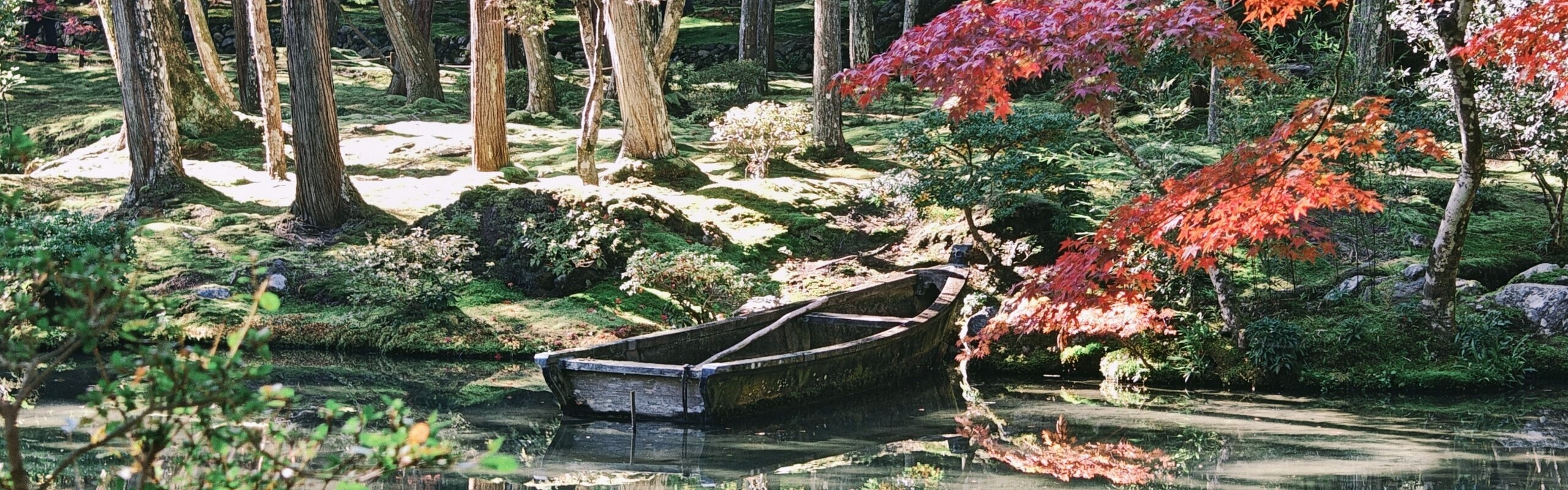
When I walked into Saihō-ji in autumn, the first thing that caught my attention wasn't the architecture. It was the thick carpet of moss under my feet.
In Chinese gardens, moss is often a small detail among rocks and trees. Here, it felt almost like part of the garden itself.
The temple devotes enormous care to maintaining it. Fallen maple leaves rested on the deep green moss, while light filtered through the trees, constantly changing the colors, shadows, and textures around me.
There was no grand landscape competing for my attention. And yet, I found it hard to look away.
I suddenly realized that I had been confusing two very different things:
Simple does not mean lacking.
The more interesting question wasn't what was missing from the garden, but rather, why did they choose to leave only these things?
Saihō-ji wasn't incapable of creating a more elaborate landscape. Instead, it allowed moss, old trees, stone paths, and shifting light to become the experience.
When there is less to look at, you start paying closer attention to what is actually there.
People stopped to look at the trees and autumn leaves. Others sat quietly on wooden benches, simply taking in the garden.
There was no long list of "must-see" sights pulling you toward the next view.
You simply looked.
That may be what fascinates me most about Japanese aesthetics:
Removing things isn't the point. Removing distractions is.
This also changed the way I think about the difference between Chinese and Japanese gardens.
Japanese and Chinese Gardens Developed Different Ways of Seeing
Chinese gardens often use rocks, water, pavilions, bridges, plants, corridors, and framed views to create a miniature world of landscapes within a limited space.
As you move through the garden, the view keeps changing. One step reveals another scene; another angle reveals something new.
Japanese gardens often work differently. By using fewer elements, they can draw your attention to the relationship between rocks, gravel, moss, trees, light, and space.
You don't always need to keep searching for another view.
Sometimes you simply sit and look at a rock, a patch of moss, or an old tree shaped by years of weather and time.
Neither approach is better than the other.
They simply developed different ways of asking us to look.
One encourages you to keep discovering new scenes. The other makes it easier to stop and really see what is already in front of you.
This is also why ideas often associated with Japanese aesthetics, such as an appreciation of imperfection, age, shadow, and change, start to make more sense.
They are not simply saying that fewer things are more beautiful.
They suggest something more subtle:
When unnecessary things step back, things we might normally overlook have a chance to be seen.
A patch of moss. A piece of weathered wood. A leaf changing color.
Suddenly, they can become the main attraction.
The same idea isn't limited to ancient temples
Later, I encountered something similar at Chichu Art Museum on Naoshima.
There was no sunlight that day.
Walking into the underground building designed by Tadao Ando, I wasn't immediately sure what I was supposed to admire. Huge expanses of exposed concrete. Simple geometric spaces. Almost no decoration.
Then I entered the Monet gallery. The Water Lilies paintings filled the space.
What stayed with me wasn't just the paintings themselves, but the way the space made me look at them.
The galleries are underground, yet natural light is carefully brought into the building. White walls, simple frames, and clean lines keep visual distractions to a minimum.
There is no elaborate decoration competing with the art. You walk in, and the paintings are simply there.
The architecture steps back so the artwork can take center stage.
The feeling reminded me of Saihō-ji, surprisingly so.
At Saihō-ji, the garden doesn't need more scenery to impress you. Moss, trees, and light are allowed to speak for themselves.
At Chichu, the architecture doesn't need to constantly call attention to itself. It steps back and lets you really see the work.
The two places look completely different, yet they seem to follow a similar principle:
Instead of adding more to create an experience, remove distractions and let perception itself become the experience.
"Less is more" no longer feels like quite the right description for Japanese aesthetics.
What's interesting isn't simply that there's less, but that someone decided what was worth keeping and what could step aside.
Japan's cultural story is also about choosing what to keep
This made me rethink the relationship between Japanese and Chinese culture, too.
When I used to notice traces of Chinese influence in Japan, I tended to think about it in terms of transmission:
What came from China? What did Japan adopt? How did the original change?
But the more I experienced these places, the less convincing that explanation felt.
Japan didn't simply copy everything it encountered.
It absorbed ideas, selected what resonated, reshaped them, and made them work within a different culture and environment.
Buddhism, for example, developed distinctive traditions in Japan. Chinese influences on gardens, tea, writing, and aesthetics also evolved into forms with their own Japanese character.
I've started to think of this process as a kind of translation.
Not copying, but choosing.
Choosing what to keep, what to change, and what needs to be understood in a new way.
Seen from this perspective, "reduction" is not just a visual quality of Japanese gardens.
It can also be part of how a culture makes something its own:
Absorb → select → reshape → make it local → express it in a new way.
What impresses me isn't that Japan learned to reproduce something from elsewhere, but that it learned to turn what it borrowed into its own language.
So perhaps Japan's "less" was never about having less
Looking back at my original assumption, I realize I may have been asking the wrong question.
I kept asking:
"Did Japan become simpler because it didn't have more to work with?"
Perhaps the more interesting question is:
"Why did it choose to leave only these things?"
Japan's geography and natural environment have certainly influenced the way people think about space, nature, and time.
But explaining Japanese aesthetics simply as the result of limited resources misses something important:
A constraint can become a choice.
A dry landscape garden doesn't need to reproduce an actual mountain and river. A few rocks and lines of gravel can suggest an entire landscape.
A garden doesn't need unlimited space to make you feel connected to nature.
A building doesn't need elaborate decoration to make light, materials, and human perception the focus.
This isn't about doing less because you can't do more.
The real art lies in deciding what doesn't need to be done at all.
What I finally came to understand about Japanese aesthetics is a respect for attention
Perhaps that is why this way of seeing things feels especially relevant in a world filled with information.
Our lives are full of sounds, colors, screens, notifications, and things constantly asking for our attention.
We are used to looking at several things at once, recording them immediately, sharing them, and then moving on to whatever comes next.
At Saihō-ji, I experienced something different.
When there is less to look at, you may actually start to see more.
You notice moss slowly covering a stone.
You watch a maple leaf turn from yellow to red before falling.
You notice how a beam of light moves through the trees.
You see how a building can step back and allow a work of art to become the focus.
That was when I began to understand why "less" can be an aesthetic choice.
"Less" doesn't mean there's nothing more to have. It means recognizing that attention is limited and choosing not to let everything speak at once.
Perhaps this is also one of the most rewarding ways to experience Japan.
Don't only ask:
"What is there to see here?"
Sometimes, ask instead:
"Why did they choose to let me see only this?"
Once you start looking at Japan this way, gardens, buildings, tea rooms, old objects, even a patch of light falling across a wooden floor, begin to feel different.
You are no longer simply looking at a beautiful place designed to be admired.
You are seeing the result of a culture making choices over time about what is worth keeping.
And now, I think that's what makes Japanese aesthetics so compelling. Not that it has less, but that it knows what to keep.